
If you're looking for an IFS therapist in Seattle, you've probably noticed the letters everywhere. In one bio, "IFS" means years of formal training through the IFS Institute. On another it means a weekend workshop and a well-thumbed copy of No Bad Parts. From the outside, they look the same.
You can tell them apart in about ten minutes. Look the therapist up in the IFS Institute's public directory, confirm their Washington license, and then ask them about their IFS therapy training directly in a free consultation. Someone who's actually trained will name their level without hedging, and they usually seem glad you asked.
TL;DR Quick Answers
IFS Therapist Seattle
A well-trained IFS therapist in Seattle can name their IFS Institute training level in one sentence and holds an active Washington license. Check both, then choose someone who's willing to go at your pace.
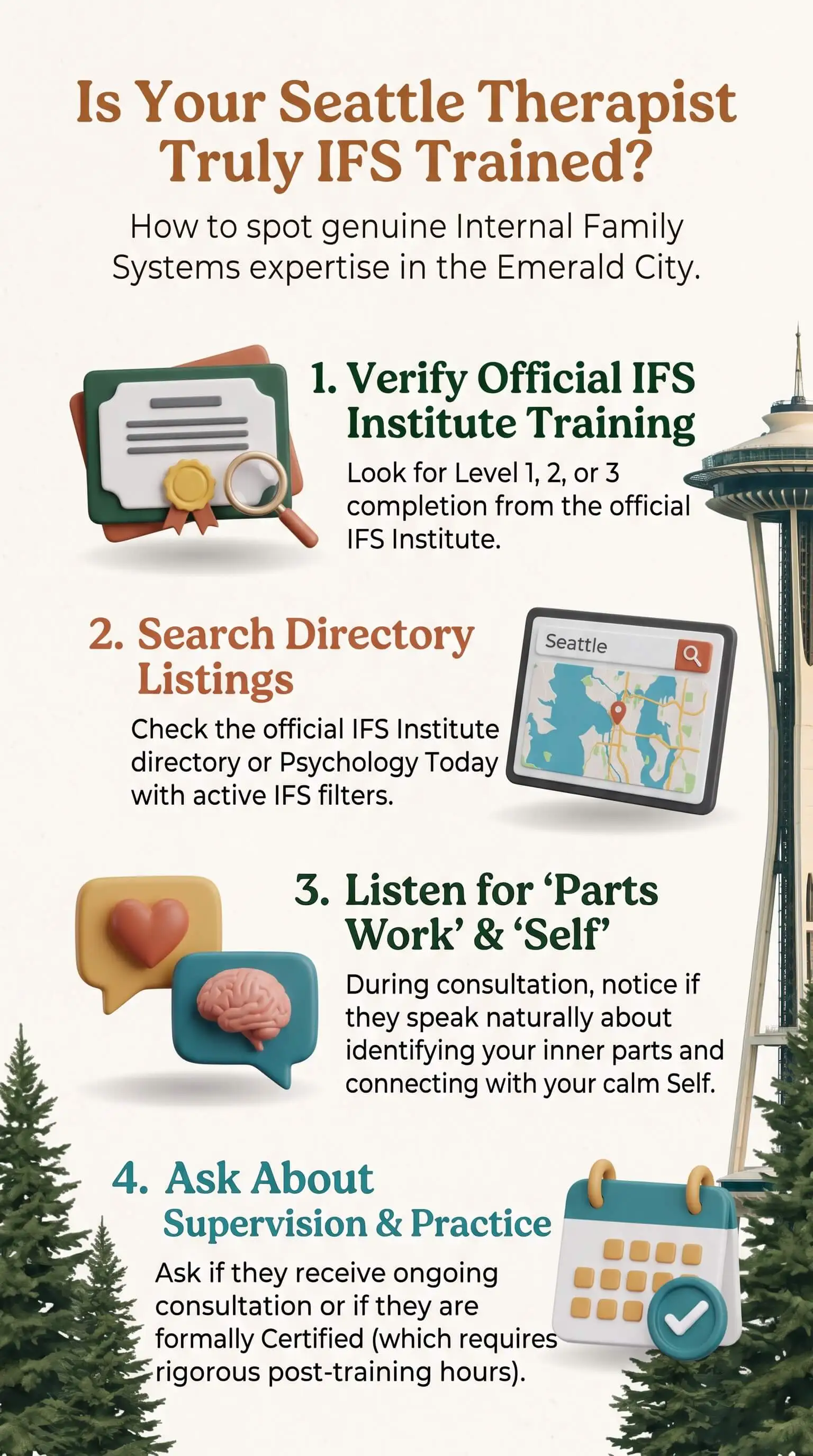
Training: search the IFS Institute directory for Level 1, 2 or 3, or Certified IFS Therapist.
License: confirm an active LMHC, LICSW, LMFT or psychologist credential with the Washington Department of Health.
Location: any Washington-licensed therapist can see Seattle clients by secure video.
Pace: IFS done well goes slowly. Anyone promising you speed with trauma is selling you something.
Example: Lauren Rath, MA, LMHC, IFS Institute Level 1 trained, offers a free 15-minute video consultation to clients anywhere in Washington.
Top Takeaways
Start with the IFS Institute's public directory. It shows the training level and certification status of every therapist listed.
Levels 1 to 3 measure training. Certification is a separate, advanced step, and every certified therapist is at least Level 1 trained.
IFS training doesn't replace a license, so confirm an active Washington credential through the Department of Health before you book.
A Washington-licensed IFS therapist can see Seattle clients by video from anywhere in the state, and the free consultation is where you'll find out whether they'll go at your pace.
What "Trained in IFS" Actually Means
When a therapist says they're trained in IFS, it should mean they've finished formal training through the IFS Institute, the organization built around Richard Schwartz's model. "IFS-informed" usually means less, and that's worth knowing before you book.
IFS works with the different parts of you. The part that rehearses every hard conversation in the shower. The critic. A younger part that still flinches when someone raises their voice. The model treats each of them as doing a job, often one it took on very early, and it trusts that underneath them is a steady Self that can lead. If you want the longer version, the IFS Institute's model outline explains it in plain language.
The Institute runs three levels of training, and certification sits on top of those as its own process. Here's what each label on a bio or directory listing tells you:
IFS Training Level 1: finished the Institute's foundational clinical training, which is structured and supervised.
IFS Training Level 2: finished Level 1 plus at least one advanced Level 2 program.
IFS Training Level 3: finished Level 1, one or more Level 2 programs, and a Level 3 program.
Certified IFS Therapist: passed a separate, advanced process showing competence in the method. Every certified therapist is at least Level 1 trained.
Approved IFS Clinical Consultant: certified, and approved to consult with other IFS therapists on their cases.
Level 1 is substantial training, and plenty of careful, skilled therapists practice there. What you're listening for is whether someone names their level plainly or lets it blur.
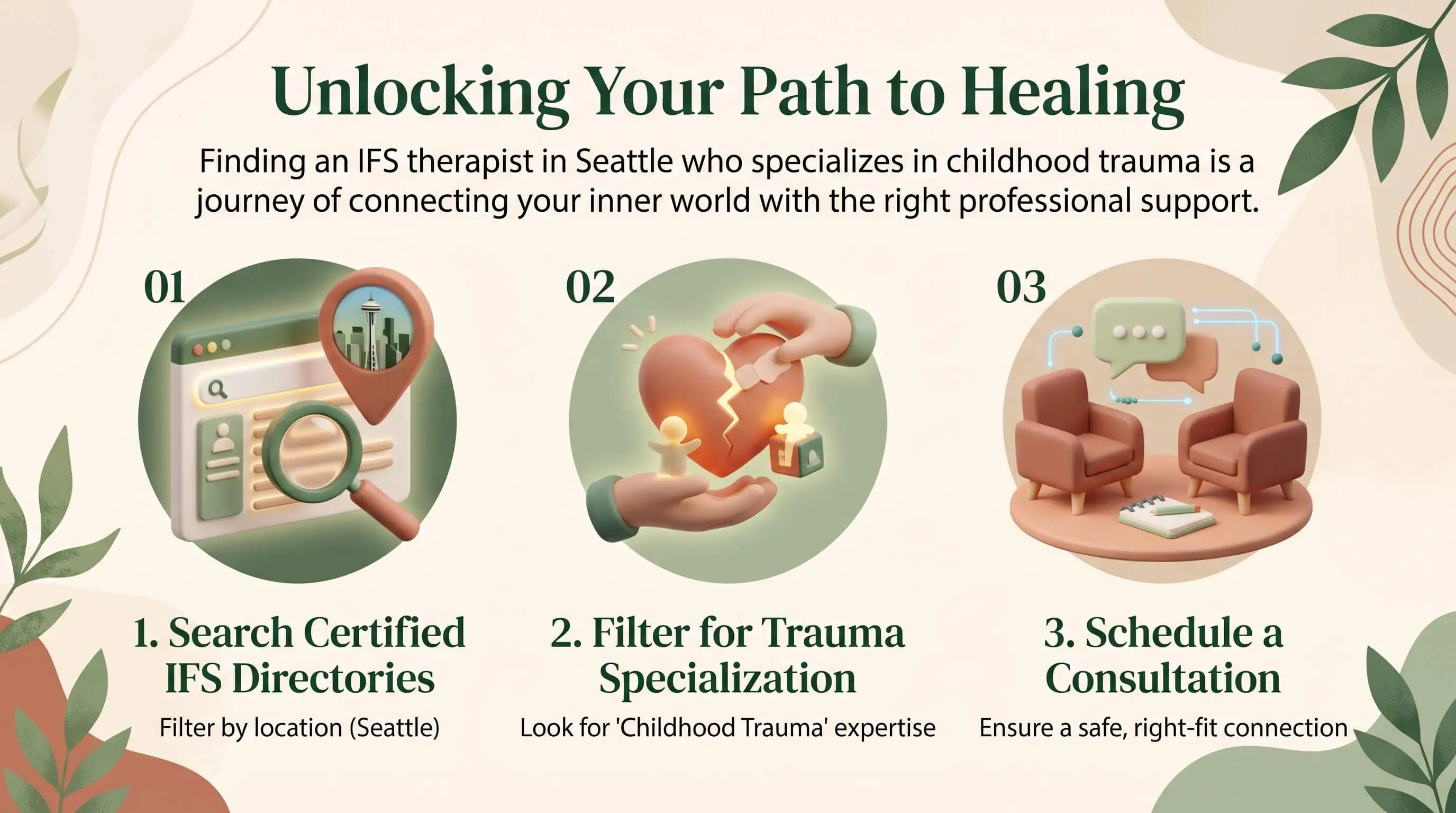
Step 1: Search the IFS Institute Directory
Start with the IFS Institute's public practitioner directory. It's the quickest check for any IFS therapist in Seattle, and each listing shows the person's training level and whether they're certified.
Two things to keep in mind while you search:
Listings are opt-in, so a trained therapist might not appear. A missing name is a question to ask, nothing more.
If a bio says "certified" and the directory doesn't, ask about the gap. Usually there's a simple explanation, and how they answer will tell you plenty.
Step 2: Confirm the Washington License
IFS training sits on top of a license and can't stand in for one. Your therapist needs an active Washington credential first, usually as an LMHC (licensed mental health counselor), LICSW (licensed independent clinical social worker), LMFT (licensed marriage and family therapist) or psychologist.
Checking takes a couple of minutes on the Washington State Department of Health Provider Credential Search. Type in a name or credential number. The Department treats the tool as a primary source for credential verification, so you'll see whether the license is active and whether any disciplinary action is on file.
Step 3: Ask These Questions in the Free Consult
Most IFS therapists offer a short consult call, and it's the best fifteen minutes you'll spend on this whole search. Bring these with you:
Which IFS Institute level have you completed, and when?
Do you still get IFS consultation or supervision?
How much of your work with clients is IFS?
What does a first session with you look like?
What do you do when one of my parts isn't ready to go further?
Notice how they answer as much as what they say. Specifics are a good sign, and polish on its own doesn't mean much. The last question matters most, because a well-trained IFS therapist slows down when a protective part pushes back. Anyone promising you speed with trauma is selling you something.
Red Flags in an IFS Therapist's Bio
None of these rules a therapist out by itself. Each one is a reason to ask a follow-up question.
"IFS-inspired" or "uses IFS techniques," with no training level named anywhere
The word "certified" with no matching directory listing
No Washington license type or number on the page
A promise that trauma can be resolved in a set number of sessions
And if a therapist gets prickly when you ask about any of this, pay attention to that. A trained clinician expects the question.
Does Your IFS Therapist Need to Be in Seattle?
No. A Washington license is what counts, not a Seattle address. Any therapist licensed in the state can see you by secure video, whether you're in Ballard, on Capitol Hill, in Fremont or across the lake in Bellevue.
That widens your options more than most people expect. If you haven't done therapy by video before, the federal guide to how telehealth visits work walks you through getting set up and what to do when the connection drops.
Lauren Rath is one example. She works with clients looking for an IFS therapist in Seattle by secure video from her practice in Spokane, and her credentials sit right on the page: MA, LMHC, IFS Institute Level 1 trained. That kind of plain disclosure is what you're looking for, from her or from anyone else on your list.
"In my consultations, the people who ask about my training are usually the ones who've been hurt before by a therapist who moved too fast. I'm glad they asked. I'll tell anyone exactly where I am: Level 1 trained through the IFS Institute, still learning. What I've seen over seven years is that the label matters less than the pace. If a therapist rushes your protective parts, those parts will close the door, and they'd be right to."
Essential Resources
IFS Institute Practitioner Directory: the official listing of IFS training levels and certification, searchable by name.
The Internal Family Systems Model Outline: the IFS Institute's own plain-language explanation of parts, exiles, managers, firefighters, and Self.
Internal Family Systems Model on Wikipedia: a neutral overview of IFS history, developed by Richard Schwartz in the 1980s, and where the research stands.
Washington DOH Provider Credential Search: verify any Washington therapist's license status and disciplinary history.
Telehealth. HHS.gov for Patients: the federal guide to getting ready for virtual visits and sorting out technical problems.
NAMI Washington: the state network of NAMI affiliates, with education programs and local support groups.
988 Suicide and Crisis Lifeline: free, confidential support by call, text, or chat, 24 hours a day. If you're in crisis, start here before you start a therapist search.
Supporting Statistics
About half of adults who need care get it. In 2022, 23.1% of U.S. adults, roughly 59.3 million people, lived with a mental illness, and only 50.6% of them received treatment that year. (National Institute of Mental Health)
Washington has more options than most states. Washington has 593.0 mental health providers per 100,000 residents, sixth in the nation and well above the national figure of 362.6. With that many names to choose from, vetting carries more weight. (America's Health Rankings, September 2025 data)
Therapy by video has become routine. A University of Michigan study of nearly 539 million Medicare visits found that telehealth accounted for 44% of all behavioral health visits through mid-2024. (University of Michigan IHPI)
With only about half of U.S. adults with mental illness receiving treatment, Washington's high number of mental health providers and the growing use of telehealth highlight the importance of finding qualified, accessible therapists. A freelance healthcare content writer can help make information about therapist credentials, treatment options, and online therapy clearer for people seeking mental health support.
Final Thoughts and Opinion
Checking a therapist's training is a way of respecting yourself, and any good therapist will see it that way too.
Seattle has plenty of therapists, and IFS has become popular enough that the letters turn up in a lot of bios. Mostly that's good news. It also means the sorting falls to you, usually when you're already tired and carrying more than you'd like.
In my view, the best signal is how a therapist reacts when you ask, more than the highest level on their certificate. The good ones name their level in a sentence and mention what they're still learning. They don't oversell, and they don't rush you, because IFS done well is slow on purpose. A protective part that's guarded something for twenty years won't step aside in one session — and a therapist who expects it to hasn't understood the model.
So give it ten minutes. Then trust what you notice in that first conversation, especially whether you felt rushed.
Frequently Asked Questions
What's the difference between IFS-trained and IFS-certified?
"Trained" means the therapist completed one or more of the IFS Institute's three training levels. "Certified" means they also went through a separate, advanced process to demonstrate competence in the method. Every certified IFS therapist is at least Level 1 trained, but not every trained therapist is certified.
Is Level 1 IFS training enough?
For many people, yes. Level 1 is substantial, structured clinical training. What matters more is whether the therapist tells you their level honestly, keeps getting consultation, and goes slowly with trauma.
How do I verify a Seattle therapist's license?
Use the Washington State Department of Health's Provider Credential Search. You can search by the therapist's name or credential number to see whether the license is active and whether any disciplinary actions are on record.
Can I see an IFS therapist in Seattle online?
Yes. Any therapist licensed in Washington can work with you by secure video wherever you live in the state, so your search doesn't stop at the city limits.
Does insurance cover IFS therapy in Washington?
Often, yes. Insurers generally cover therapy by a licensed provider rather than a specific method, so in-network therapists typically bill IFS sessions like any other therapy session. Some Washington IFS therapists, including Lauren Rath, are in-network with plans like BCBS, Aetna, Regence, Premera, and Cigna. Confirm coverage with your plan.
Why isn't my therapist in the IFS Institute directory?
Listing in the directory is opt-in, so a trained therapist may not show up there. On its own, that's no cause for worry. Ask which level they completed and when, and they should be able to tell you right away.
What should I ask in a free consultation?
Start with their IFS training level and whether they still get IFS consultation. Then ask what a first session looks like and what they do when one of your parts isn't ready to go further. That last answer tells you the most about their pace.
Start With a Fifteen-Minute Conversation
You don't have to decide anything today. Lauren Rath offers a free fifteen-minute consultation by video, with nothing to commit to. Bring the questions from this guide, including the one about her training in online IFS therapy in Washington, and she'll answer it plainly. If it doesn't feel like the right fit, you're free to say so. She sees clients anywhere in Washington and is in-network with several of the state's major insurance plans.


