Right now, someone near you is typing a health worry into Google. What they find next … a clear answer from a real practice, or a wall of jargon they bounce straight off of … often comes down to whether a freelance healthcare content writer got there first.
That's the job, more or less. I take medical information buried in research papers and busy clinicians' heads, and I turn it into pages that patients actually read, trust, and act on. One day that's a blog post. Next it's a white paper a hospital buyer uses to compare devices.
TL;DR Quick Answers
Freelance Healthcare Content Writer
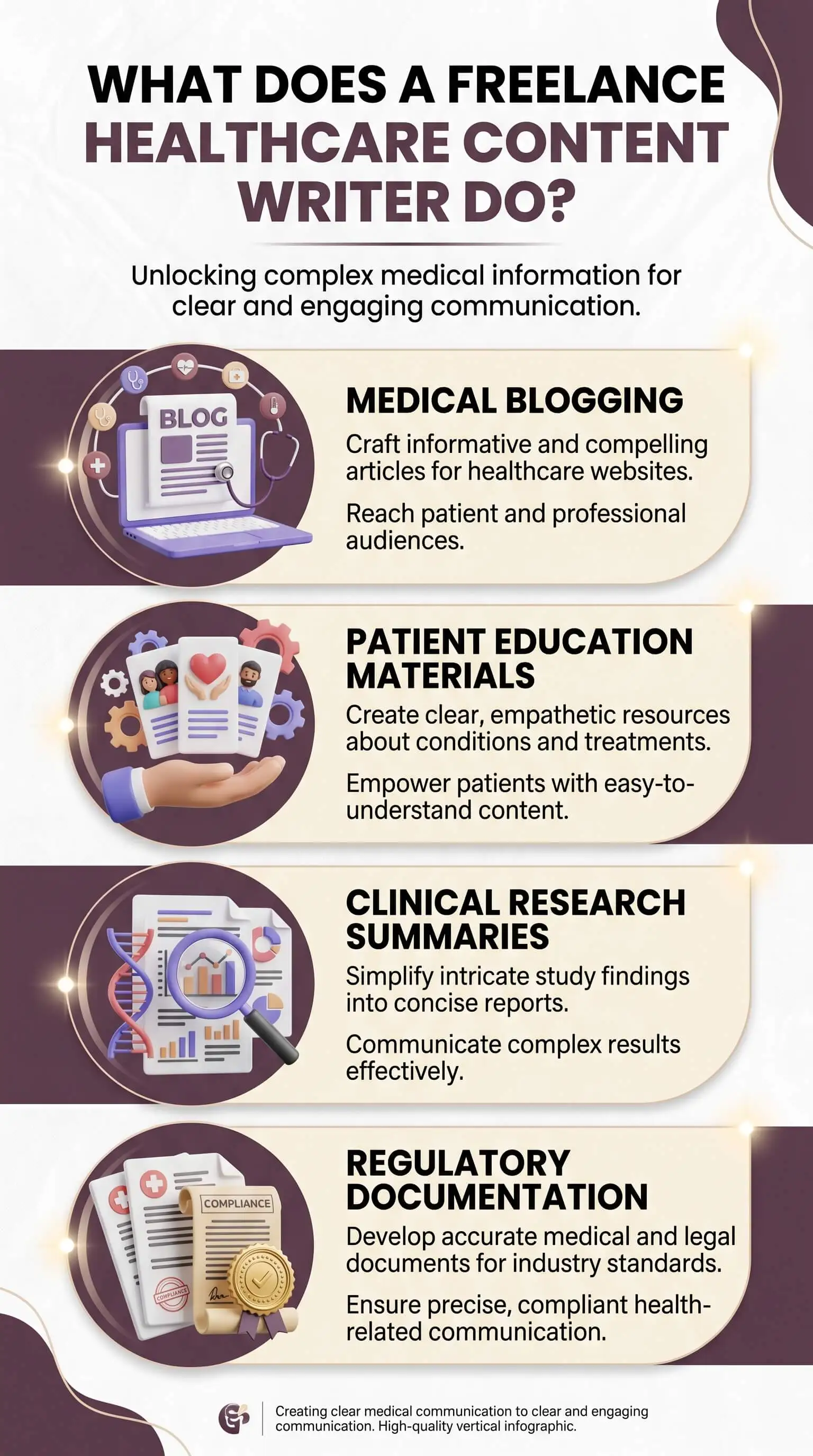
A freelance healthcare content writer is a self-employed writer who turns complex medical information into clear, accurate content that healthcare organizations use to reach patients and earn their trust. They work on contract, not as in-house employees.
Typical work includes:
Patient education articles and condition explainers
SEO blog posts and website pages
White papers and email for clinics, hospitals, telehealth, and medtech companies
The strongest ones stand out through judgment, not medical vocabulary. They know which few facts a worried patient actually needs, and they cut the rest. That judgment is the part AI still can't replace.
Top Takeaways
A freelance healthcare content writer turns complex medical information into accurate, readable content for patients, clinicians, and the people who buy healthcare services.
The work runs from patient education and SEO blogs to web copy and white papers, across clinics, hospitals, telehealth, medtech, and health brands.
Demand keeps rising because healthcare lives online now, search standards for health topics are strict, and AI drafts still need a human who knows the subject.
The writers who win do it on accuracy, clarity, and judgment, not on credentials alone.
The role is a specialized corner of the wider website content writer profession, with a clinical layer that raises both the difficulty and the value of the work.
What a Freelance Healthcare Content Writer Actually Does
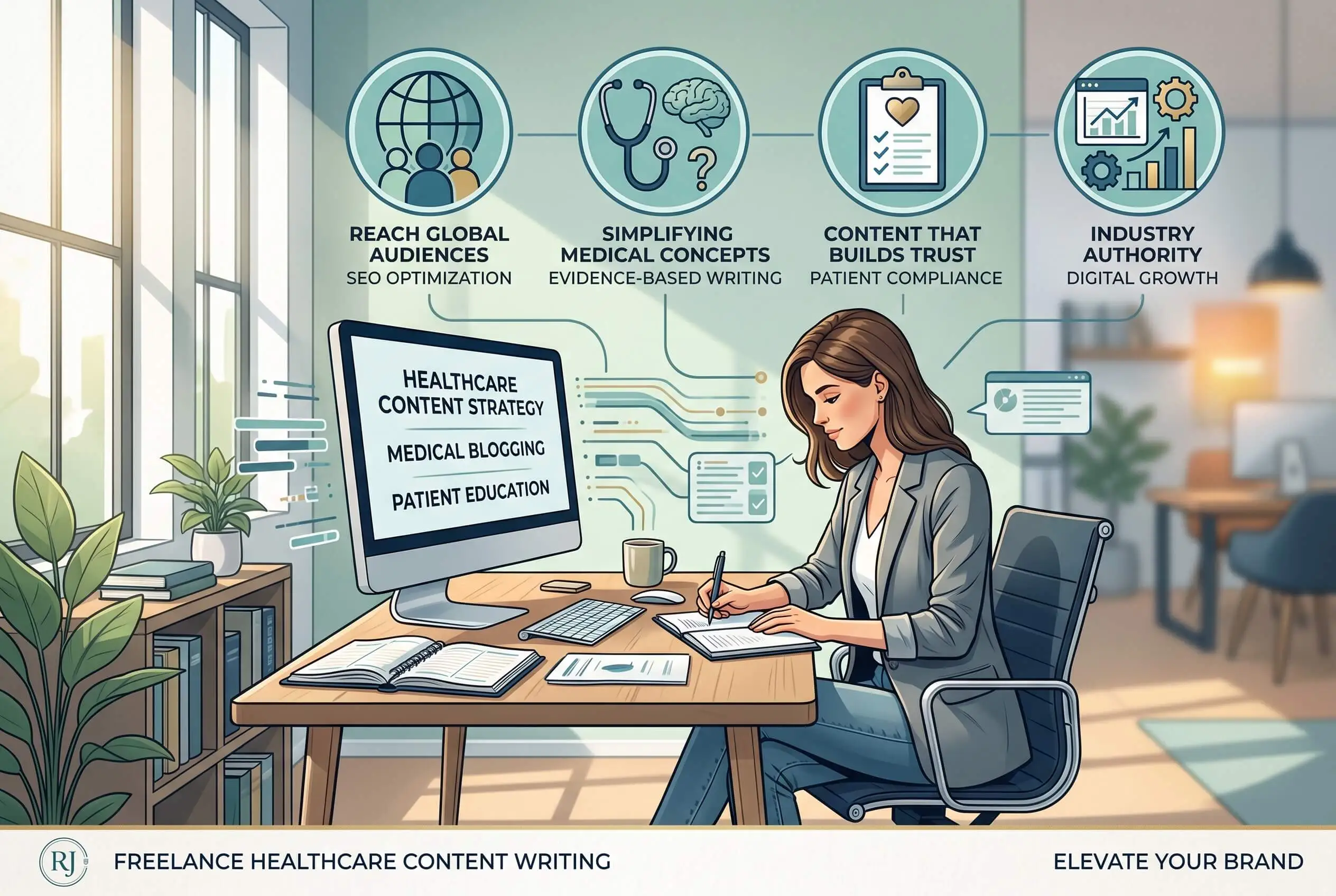
Strip away the buzzwords and the job is simple: translation. I take what's locked inside research papers, clinical guidelines, and the head of a doctor who's already running 20 minutes behind, and I rewrite it so a specific person can use it. Sometimes that person is a worried patient. Sometimes it's a physician, a caregiver, or the buyer comparing options for a hospital. The medicine stays the same, but the words, the order, and the depth change completely.
Most of the real work happens before I write a sentence. I read the source material, talk to an expert when there's one to talk to, check every claim against the actual research, and work out what the reader came to find. Only then do I draft. Then I edit it twice, once for accuracy and once for whether a tired human will make it to the end.
The Content They Create
The work is broad. In a normal month, a freelance healthcare content writer might produce:
Patient education articles and condition explainers
SEO blog posts for clinics, hospitals, and health brands
Website and landing page copy
White papers, case studies, and clinical summaries for B2B healthcare and medtech
Email newsletters and patient communication
Scripts for health videos and podcasts
The clients are just as varied: hospitals and health systems, telehealth and digital health startups, device and diagnostics companies, insurers, marketing agencies, and wellness brands. Each one wants a different voice and a different level of clinical detail, and knowing which is which is part of the skill.
Why Demand Keeps Climbing
Healthcare moved online, and it isn't moving back. Patients research a symptom, a treatment, and a provider the same way they research everything else now. They search. Content is what they find, and content is what decides whether they trust you.
Google holds health pages to a higher bar than almost any other topic, because a wrong answer about someone's health can do real damage. Thin, careless writing ranks badly and can drag a whole site's credibility down with it. The flood of AI-written drafts hasn't fixed that problem either. It has made careful human-led board game copywriting services more valuable than ever. AI is clever, but it still cannot create the kind of engaging, trust-building content that strong board game copywriting services are designed to deliver.
“Everyone assumes the hard part of healthcare writing is the medicine. The hard part is actually restraint. When I write for a clinic, I'm not trying to prove I read the study. I'm working out which three facts a scared patient needs at 11pm, then cutting the other twelve. Accuracy earns a reader's trust, and plain, honest writing is what keeps it. That's the whole job, and AI still can't do it for you.”
7 Essential Resources
Whether you're hiring a healthcare writer or trying to become one, these are the places I'd send you first. Everyone is free to dig into.
American Medical Writers Association. The main professional body for medical communicators, running since 1940. It offers training, an Essential Skills certificate, the Medical Writer Certified credential, and a community where freelancers actually find work.
Health Writer Hub. Accredited training built only for health and medical writers. The courses cover consumer health writing, medical copywriting, patient education, and the freelance business side.
Content Marketing Institute. Where I'd go to sharpen the marketing half of the craft. It explains the strategy and business goals sitting behind the content you get asked to write.
Association of Health Care Journalists. A nonprofit built around accurate, independent health reporting. Its training and freelance network are gold for any writer who wants to treat health topics responsibly.
PubMed. The U.S. National Library of Medicine's free research database. It's where a careful writer checks a claim against the real study instead of trusting a secondhand summary.
HIPAA for Professionals. The official HIPAA guidance from the U.S. Department of Health and Human Services. If you write about patients, case studies, or health data, you need to know these rules cold.
Creating Helpful, Reliable, People-First Content. Google's own guidance on what its ranking systems reward. If you write health content that needs to rank, read it twice.
Supporting Statistics
The growth here isn't a hunch. The numbers back it up.
$72,270 median pay, with steady growth ahead. Writers and authors earned a median wage of $72,270 in May 2024, and the U.S. Bureau of Labor Statistics projects the field will grow 4 percent from 2024 to 2034. Healthcare is one of the specialties pulling that number up.
$24.77 billion spent on healthcare marketing. U.S. healthcare and pharma digital ad spending hit roughly $24.77 billion in 2025, up 13.3 percent in a single year, according to eMarketer. More money in marketing means more content somebody has to write.
A telehealth market headed past $455 billion. The global telehealth market sat at $123.26 billion in 2024, and Grand View Research projects it will reach $455.27 billion by 2030, a 24.68 percent annual growth rate. Every new telehealth company needs patient education, web pages, and a steady stream of content.
Final Thoughts
If you remember one thing from this page, make it this: healthcare content writing is not regular copywriting with a few medical words dropped in. It's its own discipline. The stakes sit higher, because a reader might make a real decision about their body based on what you wrote.
My honest opinion, after doing this work for clients? The writers who last aren't always the ones with the deepest medical background. They're the ones who treat accuracy as non-negotiable, respect the reader's time, and stay genuinely curious. You can research medical knowledge. Judgment, empathy, and the discipline to cut your own clever sentences are a lot harder to fake, and those are what a healthcare brand is really paying for.
For the practices and brands reading this, the takeaway is just as blunt. Thin, generic health content has become a liability, and professional medical healthcare copywriting services are now the baseline rather than a nice-to-have.
Frequently Asked Questions
What does a freelance healthcare content writer do?
They write medical and health content, from patient guides and blog posts to web pages and white papers, for healthcare organizations on a contract basis. The real skill is taking complicated clinical information and turning it into something a specific reader can understand and use.
Why is demand for freelance healthcare writers growing?
Patients research providers and conditions online long before they call. Add strict search-quality standards for health topics, the fast growth of telehealth, and a pile of AI drafts that need human review, and you get steady demand for writers who know the subject.
What does a freelance healthcare content writer get paid?
It depends on the niche, the format, and your experience. Entry-level rates are modest. Specialists in technical or regulated areas, such as medtech and pharma-adjacent work, charge much more. As the numbers above show, writing pays a solid median wage, and healthcare sits among the better-paying lanes.
Do you need a medical background to be a healthcare content writer?
It helps, but it isn't required. Plenty of strong healthcare writers come from journalism, marketing, or general writing. What matters more is sharp research skill, a refusal to guess, and the discipline to check every claim against a credible source.
How do you become a freelance healthcare content writer?
Pick a niche, write two or three sharp samples, learn the basics of SEO, and start pitching clinics, health brands, and agencies directly. Training from a group like AMWA or Health Writer Hub can shorten the climb.
Ready to Take the Next Step?
Healthcare content keeps getting more important, and the gap between generic writing and the specialist kind keeps getting wider. If you run a practice or a brand, take an honest look at your current health content and ask whether it earns a reader's trust. If you're a writer, pick your niche this week and start your first sample. The demand is real, and it isn't slowing down.